Table of Contents
ToggleHow did mobile tech change gaming?
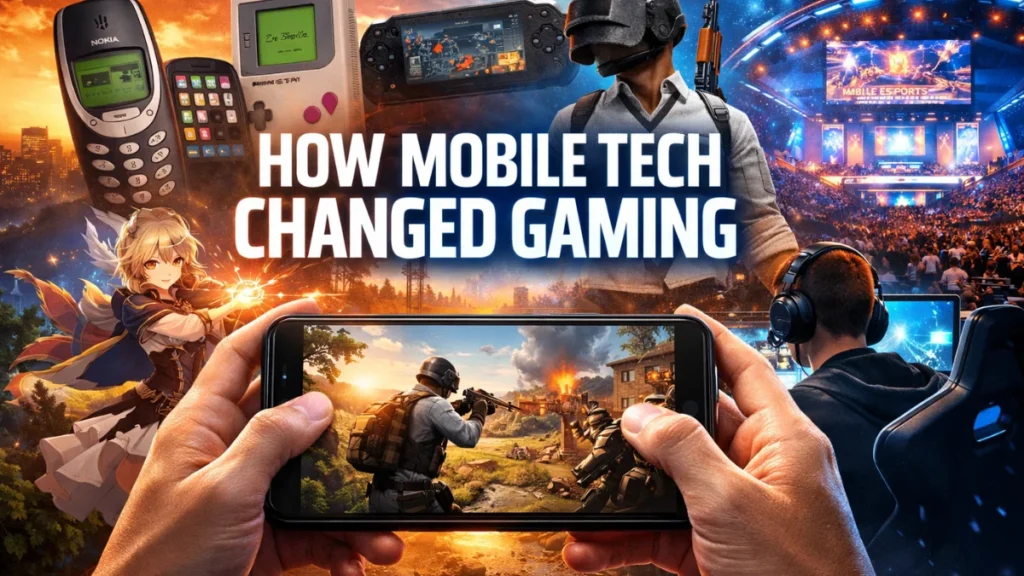
Mobile tech changed gaming by making high-quality games accessible anytime, anywhere on smartphones. This eliminated the need for dedicated hardware, introduced free-to-play business models, and expanded the global gaming market from millions to billions of players — transforming gaming into the world’s largest entertainment medium.
The Pre-Mobile Gaming Landscape
Understanding these early barriers makes it easier to see how mobile tech changed gaming by removing cost, location, and accessibility limitations.What was gaming like before mobile technology? Gaming required dedicated devices — consoles, PCs, or handheld systems like the Game Boy and PSP. The mobile gurus at WaveTechGlobal recall an era when gaming meant stationary play sessions tied to a TV or desk, with significant hardware investments required just to participate.
Traditional gaming presented real barriers to entry that mobile tech would eventually dismantle entirely:
- High entry costs — $300–500 for consoles, $800–1,200 for gaming PCs
- Location-dependent gameplay — tied to a TV or fixed monitor
- Limited multiplayer — requiring LAN setups or dedicated servers
- Physical game purchases — costing $40–70 per title
- Narrow demographics — predominantly young males in developed markets
These barriers kept gaming a niche hobby for decades. Mobile tech changed gaming by removing every single one of them simultaneously, opening the door to a truly global audience.
The Mobile Gaming Revolution Timeline
How did mobile tech change gaming step by step? The transformation happened across four clear phases.
2007–2010: Foundation Era — Apple’s App Store launch in 2008 democratized game distribution overnight. Games like Angry Birds proved mobile gaming’s commercial viability and showed that touchscreen controls could create genuinely accessible gameplay for non-traditional audiences.
2011–2015: Mainstream Adoption — According to WTGTechGeek technology trends analysis, smartphone ownership grew from 35% to 77% of US adults during this period. Clash of Clans and Candy Crush demonstrated that free-to-play with in-app purchases could generate billions in revenue, reshaping the entire gaming industry’s financial model.
2016–2020: Technical Sophistication — Advanced mobile processors enabled console-quality visuals on smartphones. PUBG Mobile and Fortnite brought AAA gaming experiences to pocket devices, while 5G connectivity enabled low-latency online multiplayer previously impossible on cellular networks.
2021–Present: Maturity and Innovation — Cross-platform play became standard, with Genshin Impact synchronizing progression across mobile, console, and PC simultaneously. Competitive mobile gaming matured into a legitimate esports sector with million-dollar prize pools and dedicated professional infrastructure worldwide.
Technical Innovations That Enabled Mobile Gaming
These technological breakthroughs are central to understanding how mobile tech changed gaming at both performance and accessibility levels.Multiple converging technologies transformed smartphones into legitimate gaming platforms.
Processor Evolution — Mobile chipsets like Apple’s A-series and Qualcomm’s Snapdragon 8 Gen 3 now deliver console-level performance in smartphone form factors. This progression took less than fifteen years and fundamentally changed what mobile gaming could offer players.
Display Technology — OLED screens with 120Hz refresh rates and HDR10+ support deliver visual quality exceeding many dedicated gaming monitors. Samsung and Apple displays consistently set the industry’s visual benchmarks.
Battery Optimization — Efficient power management now enables 4–6 hours of intensive gaming. Fast charging achieving 50% capacity in under 15 minutes keeps players in the game longer with minimal interruption.
Game Engines — Unity and Unreal Engine simplified cross-platform development, allowing studios to target mobile alongside console releases simultaneously rather than treating mobile as an afterthought. This dramatically increased the quality and quantity of titles available.
Adaptive Controls — Smart touch interfaces adjust to hand position and play style in real-time, reducing input errors significantly and making complex competitive gameplay viable on touchscreens for the first time.
Business Model Transformation
A major reason how mobile tech changed gaming lies in its revolutionary monetization strategies.Mobile introduced monetization strategies that fundamentally altered industry financial structures — and that console and PC gaming have since widely adopted.
Key Insight from WaveTechGlobal: 98% of mobile game revenue comes from just 2% of players. Understanding this dynamic is essential to understanding why mobile gaming’s business models look so different from traditional gaming.
- Free-to-Play Dominance — Removing upfront costs converted billions of casual users into active players, expanding the total addressable market exponentially
- Battle Pass Systems — Seasonal content passes deliver predictable recurring revenue while rewarding engaged players with exclusive cosmetic items
- Rewarded Advertising — Video ads offering gameplay benefits generate revenue without ever charging players directly
- Gacha Mechanics — Randomized item systems generate massive revenue through collection psychology borrowed from Japanese mobile gaming culture
- Subscription Services — Apple Arcade and Google Play Pass deliver curated ad-free gaming libraries monthly, mirroring the Netflix model for interactive entertainment
These innovations did not stay confined to mobile. Console gaming’s widespread adoption of battle passes and seasonal content directly reflects how mobile tech changed gaming’s economic assumptions across every platform.
Social and Cultural Impact
Who plays mobile games today? Everyone. Mobile gaming demolished every demographic stereotype associated with traditional gaming audiences and created the most diverse player base in entertainment history.The rapid market expansion highlights how mobile tech changed gaming on a global cultural scale.
Market Size Growth:
| Year | Revenue | Growth |
| 2010 | $2.5 Billion | Baseline |
| 2015 | $25 Billion | 10× |
| 2020 | $77 Billion | 3× |
| 2024 | $98 Billion | — |
| 2026 | $116 Billion | Projected |
Mobile gaming now represents 50% of the $200+ billion global gaming market — surpassing console and PC gaming combined. That single statistic captures exactly how mobile tech changed gaming’s scale and cultural reach.
Demographic Shift: According to the WaveTechGlobal mobile tech research team, 46% of mobile gamers are female compared to just 30% for console gaming. The average mobile gamer is 36 years old, players span every socioeconomic background, and the geographic distribution is genuinely global in ways no previous gaming platform ever achieved.
Regional Leadership: Asia-Pacific dominates global mobile gaming, with Tencent and NetEase controlling major revenue streams. Honor of Kings alone generates over $2 billion annually. Meanwhile India, Southeast Asia, and Latin America are the fastest-growing markets as smartphone penetration continues rising.
Competitive Gaming and Mobile Esports
Are mobile esports legitimate? Without question. Professional mobile gaming now rivals traditional esports in viewership, prize money, and professional infrastructure.
| Tournament | Prize Pool | Peak Viewership |
| PUBG Mobile Global Championship | $4M+ | 80M+ viewers |
| Mobile Legends World Championship | $3M+ | 100M+ viewers |
| Free Fire World Series | $2M+ | 500M+ viewers |
| Call of Duty Mobile World Championship | $1M+ | 60M+ viewers |
Top mobile esports professionals earn six-figure salaries plus brand sponsorships — a career path that simply did not exist when the first iPhone launched in 2007. The Blade Soul Revolution clan system further demonstrates mobile gaming’s depth. According to the clan guide WaveTechGlobal published, successful clans implement role specialization, cross-timezone scheduling, and structured resource sharing — coordination systems matching the complexity of PC MMORPG guilds.
Working From Home and Mobile Gaming
How did remote work change mobile gaming behavior? Working from home permanently blurred the line between work and leisure, creating new gaming patterns that mobile devices are uniquely positioned to serve. As WaveTechGlobal’s working from home guide documents, smartphones became the default entertainment device for the global remote workforce almost overnight.
Working from home with Apple devices enables particularly seamless gaming integration — start a session on iPhone during lunch, continue on iPad in the evening, with progress synchronized automatically through iCloud across all devices.
Key behavioral trends observed by the WaveTechGlobal team:
- Short casual sessions filling work breaks at 10–15 minutes each
- Lunchtime gaming replacing commute entertainment entirely
- Longer evening sessions replacing time previously spent commuting
- Cross-device play spanning mobile during work hours and console afterward
- Social gaming filling casual interaction that office environments previously provided
Future Mobile Gaming Predictions
What comes next? Based on WTGTechGeek technology trends analysis, mobile gaming’s next phase will make today’s titles look primitive by comparison.
Near-Term (2025–2027):
- AI Integration — Dynamic difficulty and personalized content creating individually tailored experiences at scale
- AR Expansion — Persistent shared augmented reality layers enabled by improved sensors and 5G
- Cloud Gaming Maturity — Streaming becoming the primary delivery method, eliminating all hardware barriers globally
- Cross-Platform Unification — Full cross-play making device choice completely irrelevant
Long-Term (2028–2030):
- 6G Networks — Near-instant cloud rendering indistinguishable from local processing
- Holographic Displays — Glasses-free 3D projection transforming mobile visual experiences entirely
- Neural Interface Gaming — Brain-computer interfaces enabling early thought-controlled gameplay
Frequently Asked Questions
How did mobile tech change gaming forever?
Mobile tech changed gaming by eliminating hardware barriers, introducing free-to-play models, and expanding the global gaming audience to billions. The $98 billion mobile gaming market now surpasses console and PC gaming combined.
Who plays mobile games in 2025?
46% of mobile gamers are female, the average age is 36, and players span every income level globally — the most demographically diverse gaming audience ever assembled on a single platform.
Are mobile esports legitimate?
Yes. PUBG Mobile offers $4M+ prize pools, Free Fire attracted 500M+ viewers, and top professionals earn six-figure salaries — fully comparable to traditional esports in scale and professionalism.
How does working from home affect mobile gaming?
Remote work created new gaming windows — lunchtime sessions, break-time play, and evening gaming replacing commute time. Working from home with Apple devices enables seamless cross-device play with synchronized cloud saves.
Conclusion
Mobile tech did not simply change gaming — it completely redefined what gaming means, who gamers are, and how games are experienced worldwide. What began with basic Nokia games and Angry Birds evolved into a $98 billion industry that now dominates global entertainment, surpassing both console and PC gaming combined.
The key takeaways from the gurus at WaveTechGlobal are clear. Mobile democratized gaming access across every demographic, income level, and geography. Free-to-play business models transformed how games generate revenue. Technical hardware advancements delivered console-quality experiences in every pocket. Competitive esports proved mobile gaming’s legitimacy at the highest professional level. And the rise of remote work permanently embedded mobile gaming into daily routines worldwide.
As Stewart from WaveTechGlobal often says — the best gaming platform is the one already in your pocket, ready to play anytime, anywhere. The question is no longer whether mobile gaming is real gaming. For billions of players worldwide, mobile gaming simply is gaming.
The future is even more exciting. With AI personalization, AR expansion, cloud gaming maturity, and 6G networks on the horizon, the mobile gaming revolution that started in 2007 is nowhere near finished. WaveTechGlobal’s mobile gurus will continue tracking every development, bringing you the latest insights across WTGTechGeek, WTGTechTrends, WTGTechAble, and WTGSmartHome.
Explore more posts on TechSaasWrote. We create every article with care to share practical insights and clear information. All content and images are produced with the support of ThreeBoysTime to maintain high quality, creativity, and accuracy.