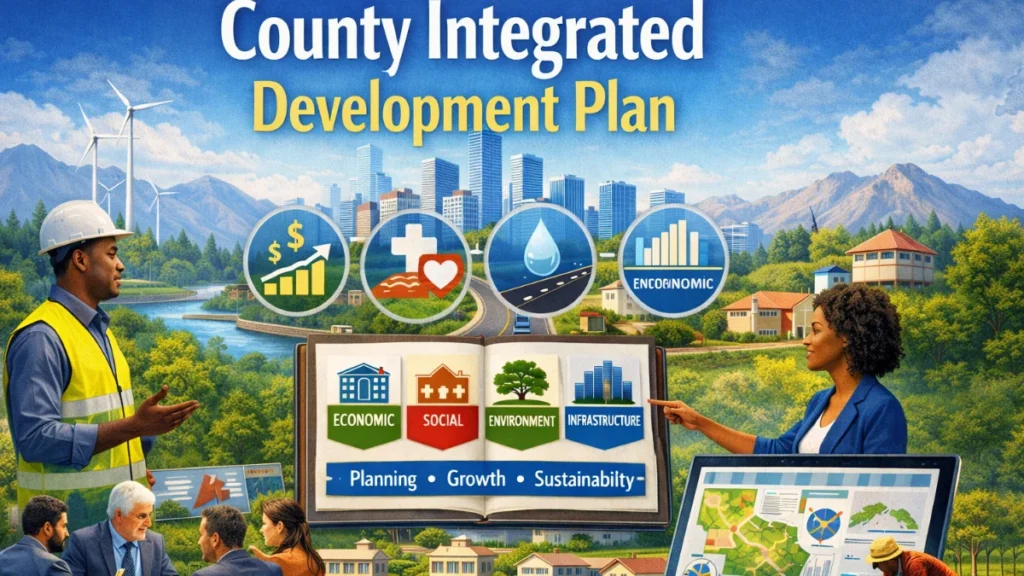
In my experience working around local governance discussions and development programs, the County Integrated Development Plan often becomes the backbone of effective county planning. A well-prepared CIDP acts as a strategic blueprint that guides county development through a clear roadmap for long-term growth. Instead of isolated actions, counties rely on unified planning that connects integrated sectors and focuses on community needs while supporting inclusive development.
At its core, the County Integrated Development Plan functions as a formal policy document supported by a strong governance framework and practical planning framework. It allows leaders to organize economic priorities, social priorities, environmental priorities, and infrastructural priorities into a balanced development roadmap. Through coordinated planning, counties strengthen transparent governance, improve responsible resource allocation, and combine governance planning, development integration, and strategic governance to achieve sustainable growth and long-term regional development.
Table of Contents
ToggleWhat Is a County Integrated Development Plan
A County Integrated Development Plan is a multi-year strategic plan prepared by the county government to guide development over a five years planning period. Through a structured approach, it outlines key development priorities, development policies, and investment strategies that shape the direction of local growth and provide a practical development framework for government planning.
The plan ensures attention to important sectors such as infrastructure development, healthcare services, education systems, and the agriculture sector, all of which support food security, strengthen social services, and improve community welfare. By aligning development initiatives with national development goals and defining clear sector priorities, counties can promote economic growth, encourage job creation, and manage environmental conservation through a clear policy strategy and governance strategy.
Why a County Integrated Development Plan Matters
The primary purpose of a County Integrated Development Plan is to promote coordinated development and avoid fragmented development caused by inefficient planning. Through proper structured planning, counties can work toward shared objectives, improving service delivery improvement while ensuring effective resource allocation.
Since counties often operate with limited budgets, planners must focus on prioritizing projects based on urgency, feasibility, and accurate impact assessment. Through careful funds allocation, combined with community consultations, stakeholder engagement, and a participatory approach, governments strengthen transparency, build public trust, increase accountability, and encourage sustainable growth while supporting environmental considerations, ecological preservation, and balanced economic progress.
Key Components of a County Integrated Development Plan
A well-designed County Integrated Development Plan begins with situational analysis that examines the current county status, including population demographics, economic activities, natural resources, and the existing infrastructure condition. These insights, together with social development indicators, help planners identify development gaps and uncover development opportunities.
After this assessment, counties establish a vision statement and mission statement that outline long-term aspirations. The plan then defines strategic objectives, measurable goals, and clear progress benchmarks for tracking development priorities, while sectoral plans guide development in the health sector, agriculture sector, transport sector, education sector, and water services through an implementation framework, supported by timelines, responsible departments, funding sources, monitoring mechanisms, monitoring evaluation, and performance indicators.
Planning Process of a County Integrated Development Plan
The planning process for a County Integrated Development Plan usually begins with organized preparation stages that involve data collection, detailed research, and analysis of statistical data gathered through surveys. These studies help planners understand socio-economic trends and identify emerging development needs.
The process continues with stakeholder engagement through community forums, public hearings, and consultations with businesses, NGOs, and civil society groups, ensuring inclusive participation. After drafting and document review by planning experts, the draft document undergoes stakeholder review before receiving approval and adoption from the county assembly or another governing body, allowing departments to begin implementation and executing projects according to plan priorities.
Role of Stakeholders in a County Integrated Development Plan
A successful County Integrated Development Plan relies on strong cooperation among different stakeholders, where effective collaboration ensures that development projects benefit from shared knowledge and resources. The county government typically leads the process by drafting plan documents and managing funding implementation.
At the same time, the national government provides policy guidance, regulatory frameworks, and sometimes financial support. The private sector contributes through infrastructure investment, housing investment, and other economic development initiatives, while civil society organizations, NGOs, and active citizens participation strengthen community mobilization, provide specialized services, offer consultations input, and ensure leadership accountability and proper implementation oversight.
Benefits of a County Integrated Development Plan
One of the key outcomes of a County Integrated Development Plan is improved infrastructure, including stronger road networks, reliable water supply systems, and modern public facilities. These improvements promote structured development and ensure prioritized development across communities.
The plan also supports enhanced economic growth by identifying key economic sectors, encouraging investment promotion, and expanding job creation. Through improved social services improvement, better healthcare services, stronger education systems, and expanded social protection programs, counties can also promote environmental protection, responsible land use, and effective conservation strategies while implementing climate adaptation strategies that maintain governance continuity and long-term stability.
Key Obstacles in Implementing a County Integrated Development Plan
Despite its benefits, implementing a County Integrated Development Plan often involves several implementation challenges, especially when counties face limited funding and insufficient budgets. These financial limitations can result in delayed projects or scaled projects that fail to achieve their intended goals.
Other barriers include political interference and shifting political priorities, which can create disrupted continuity in development programs. In addition, weak monitoring systems, ineffective tracking, capacity constraints, and lack of technical expertise, planning expertise, and project management skills can slow implementation momentum, making strong institutional frameworks and continuous capacity building initiatives essential.
Integration with National and Global Development Goals
Successful development planning requires counties to connect their plans with wider integration frameworks. Aligning the County Integrated Development Plan with national development strategies, national vision plans, and long-term policy agendas helps maintain policy consistency across government levels.
Many counties also align their planning with the Sustainable Development Goals (SDGs) to support global targets while achieving national targets. Through strong local planning alignment, policy alignment, and strategic alignment, counties contribute to broader cohesive development and unified development efforts.
Digital Transformation in County Planning
Modern development planning increasingly depends on digital transformation and advanced planning technology. Tools such as Geographic Information Systems and GIS mapping allow planners to analyze infrastructure distribution, land use, and development patterns more accurately.
In addition, digital public participation platforms allow communities to contribute ideas more easily, while online monitoring dashboards support data driven decision making. These innovations strengthen digital governance, improve transparency tools, support efficiency improvement, and expand accessibility enhancement for public planning information.
Future Trends in County Integrated Development Planning
Looking ahead, several future trends are shaping development planning, particularly planning innovation through climate resilient planning and climate risk assessments integrated into modern development strategies.
At the same time, smart infrastructure, technology driven solutions, traffic management systems, waste disposal systems, and improved energy efficiency are transforming urban planning. Increasing public private partnerships, government collaboration, and investment from private investors are also expanding infrastructure funding, while inclusive development models promote gender equality, youth empowerment, and marginalized communities inclusion.
Strategies for Building an Effective County Integrated Development Plan
Successful counties follow important best practices when implementing development plans. The process often begins with comprehensive baseline studies that provide reliable data for planning decisions and guide policy design.
Maintaining continuous public engagement, setting measurable targets, and establishing realistic planning targets help improve accountability. Through transparent procurement systems, consistent progress monitoring, regular monitoring, timely plan updates, and emerging needs adaptation, governments can strengthen community collaboration, encourage strong leadership, and achieve long-term planning success strategies.
Frequently Asked Questions
What does a County Integrated Development Plan involve?
A County Integrated Development Plan (CIDP) is a strategic document prepared by a county government to guide development activities over a specific period, usually five years. It outlines development priorities, policies, and investment strategies that help counties achieve economic growth, social development, and environmental sustainability.
Why is a County Integrated Development Plan important?
A County Integrated Development Plan is important because it helps counties coordinate development efforts, allocate resources effectively, and ensure transparency in governance. It also allows governments to plan infrastructure, social services, and economic initiatives in a structured and sustainable way.
What main elements make up a County Integrated Development Plan?
The main components of a County Integrated Development Plan include situational analysis, a vision and mission statement, strategic objectives, sectoral development plans, and an implementation framework. It also includes monitoring and evaluation systems to track progress and ensure that development goals are achieved.
Who participates in developing a County Integrated Development Plan?
The development of a County Integrated Development Plan involves multiple stakeholders, including the county government, national government, private sector, civil society organizations, NGOs, and local citizens. Public participation helps ensure that development projects reflect community needs and priorities.
Conclusion
A well-structured County Integrated Development Plan promotes structured growth by aligning economic priorities, social priorities, environmental priorities, and infrastructural priorities within a single cohesive framework. This integrated framework allows counties to turn their development vision into practical development action.
Through effective strategic planning, strong stakeholder engagement, and consistent implementation monitoring, counties can achieve quality of life improvement, greater economic prosperity, and stronger resilient communities. By focusing on integrated county planning, governments ensure meaningful progress, sustainable development, and lasting development for future generations.