Search intent mapping is one of the most useful ways to turn SEO from a traffic exercise into a proper lead generation strategy. It helps you understand what your buyers are really looking for, why they are searching, and which page should answer their question.
If your website attracts visitors but does not turn enough of them into enquiries, the issue may not be your rankings alone. It may be that your pages are not matched to the right stage of the buyer journey. A service page may be trying to answer an early research question, while a blog post may be attracting people who are ready to buy but have nowhere clear to go next.
For a UK business competing online, this matters. The UK had 5.7 million private sector businesses at the start of 2025, which means your prospects have plenty of choice before they speak to you. Working with a specialist partner such as Totally Digital SEO agency can help you build a search strategy around real buyer behaviour, not just keyword volume.
Search intent mapping helps you avoid wasted content, weak landing pages and low-quality traffic. Instead of asking, “What keywords can we rank for?”, you start asking, “What does this buyer need to know before they are ready to trust us?”
Table of Contents
ToggleWhat Is Search Intent Mapping?
Search intent mapping is the process of matching search queries to the right type of page based on what the user wants to achieve.
Some people are looking for information. Some are comparing options. Some are ready to contact a supplier. Others are simply trying to understand a problem before they know what service they need.
For example, someone searching “why are my Google Ads leads poor quality?” is likely looking for guidance. Someone searching “PPC agency for B2B lead generation” is much closer to choosing a supplier. These two searches should not be treated the same.
If you send both visitors to the same generic page, one may feel rushed and the other may feel under-informed. Search intent mapping helps you create the right page for the right moment.
Why Search Volume Can Mislead You
Many businesses still choose keywords based mainly on search volume. High-volume keywords can look attractive because they suggest lots of potential traffic. But traffic is not always valuable.
A broad keyword may bring thousands of visitors who are students, job seekers, DIY researchers or people looking for free advice. A lower-volume keyword may bring fewer visitors but more serious buyers.
This is especially important when every enquiry has a real commercial value. If your average client is worth £5,000, £20,000 or £50,000 over time, you do not need thousands of casual visitors. You need the right people landing on the right pages with enough confidence to take the next step.
Search intent mapping helps you separate vanity traffic from commercial opportunity.
The 4 Main Types Of Search Intent
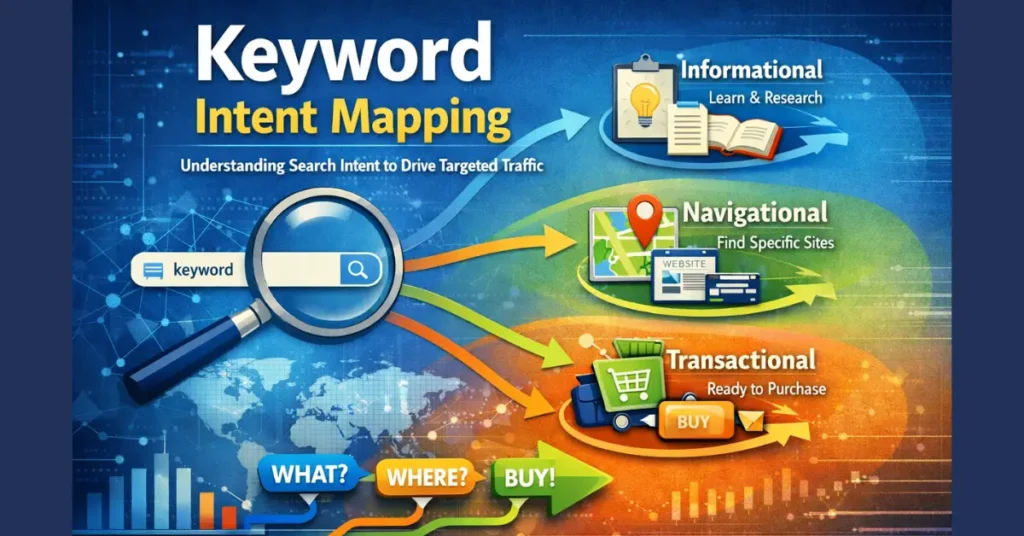
Most search queries fall into 4 broad groups: informational, commercial, navigational and transactional.
Informational searches are used when someone wants to learn. They may search for “how to improve website conversion rate” or “what is technical SEO?” These searches are useful for educational articles, guides and explainers.
Commercial searches happen when someone is comparing options. They may search for “SEO agency vs in-house SEO” or “best marketing strategy for B2B companies”. These searches need comparison content, buyer guides and practical advice.
Navigational searches are brand or website-specific. Someone may search for your company name, a service page, a case study or a client login area. These searches need clear brand pages and a strong site structure.
Transactional searches show stronger buying intent. Examples include “SEO audit agency UK”, “technical SEO consultant London” or “Google Analytics setup service”. These searches usually need service pages, landing pages and strong calls-to-action.
How To Match Pages To Buyer Questions
The simplest way to start is to list your core services, then write down the questions buyers ask before they enquire.
For each service, think about what your buyer asks at different stages. Early-stage questions may include “why is our traffic dropping?” or “why are leads not converting?” Mid-stage questions may include “should we invest in SEO or PPC?” Late-stage questions may include “how much does an SEO audit cost?” or “what should an SEO agency include?”
Once you have these questions, match each one to a page type. A broad educational question may need a blog article. A comparison question may need a guide. A high-intent service query may need a dedicated service page. A pricing question may need a transparent explanation that helps people understand likely investment.
This gives every page a purpose. It also stops you from creating several pages that compete with each other for the same keyword.
Why Service Pages Should Not Try To Do Everything
A common mistake is forcing one service page to answer every possible buyer question. The result is often a page that is too broad, too long or too unclear.
Your service page should focus on people who already understand the problem and are considering help. It should explain what you do, who it is for, the problems you solve, your process, proof of experience and how to enquire.
More educational questions can be handled through supporting content. For example, a technical SEO service page can be supported by articles about crawlability, indexing, site speed, migrations and duplicate content.
This structure helps users move naturally from learning to enquiry. It also gives search engines a clearer understanding of your topical authority.
Use Internal Links To Guide The Buyer Journey
Search intent mapping does not stop when the page is published. You also need to connect pages together.
If someone reads an article about why their website is not generating leads, the next logical step may be a conversion rate optimisation page, SEO audit page or website strategy page. If someone reads a comparison between SEO and PPC, you can link them to both service pages so they can explore the right option.
Internal links help users move through your website without feeling forced. They also help search engines understand which pages are most important.
Think of your website as a guided journey. Every useful article should lead somewhere relevant. Every service page should answer enough questions to reduce doubt. Every call-to-action should feel like a natural next step.
How Search Intent Supports Better Lead Quality
When your pages match real buyer questions, your leads usually improve.
People arrive with better expectations because your content has already explained what you do and who you help. They understand the problem more clearly. They can see whether your service is suitable. They are less likely to enquire for the wrong reason.
This matters because low-quality leads cost time and money. Your sales team may spend hours speaking to people with no budget, no authority or no genuine need. Even if your traffic looks strong, poor-fit enquiries can still weaken your results.
The UK digital advertising market reached £40.5bn in 2025, which shows how competitive online attention has become. With so much money being spent to attract clicks, your organic strategy needs to work harder to attract people who are actually worth speaking to.
Measure Intent, Not Just Rankings
Rankings are useful, but they do not tell the whole story. A page ranking in position 1 for the wrong intent may generate little value. A page ranking lower for a highly relevant commercial query may produce better enquiries.
You should measure which pages generate meaningful actions, such as form submissions, calls, booked consultations, downloads, demo requests or qualified leads. You should also look at assisted conversions, because early-stage content may influence a buyer long before they enquire.
Over time, this data helps you improve your intent map. You can update pages that attract the wrong visitors, expand content that supports strong enquiries and build new pages around gaps in the buyer journey.
Build Your SEO Around Real Buyer Questions
Search intent mapping helps you create a website that feels more useful, more relevant and more commercially focused. Instead of publishing content just to target keywords, you build pages that answer the questions your buyers are already asking.
That means better service pages, stronger supporting articles, clearer internal links and fewer wasted visits. It also helps you move away from chasing low-quality traffic and towards building a search strategy that supports real enquiries.
If your website is ranking but not converting, or if your content feels disconnected from your sales process, search intent mapping is a sensible place to start.
Ready To Turn Search Intent Into Better Enquiries?
If you want your SEO strategy to attract the right people at the right stage, start by mapping your pages to real buyer questions. Review what each page is for, who it serves and what the visitor should do next.
Get in touch today to build a clearer, more commercially focused SEO strategy that turns search visibility into better-quality enquiries.